57 cm charcoal kettle
The one most people mean by 'a barbecue', and far more capable than its price suggests once the coals go to one side.
- Runs on Lump charcoal or Charcoal briquettes
- Smoke Charcoal combustion, Wood chips, Oak chunks
- Attention A look every few hours
- Feeds A family
- Learning Takes a few cooks
- Moving it Movable, with effort
What it is good at, and what is harder
What it is good at
- Does both jobs. Coals spread out is a hot grill; coals banked to one side is a genuine indirect oven, and swapping between them takes seconds.
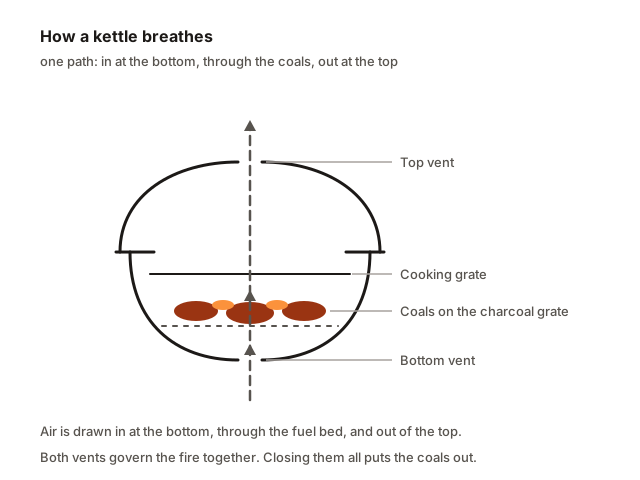
- Two vents give real control over a charcoal fire, which is the difference between cooking on charcoal and fighting it.
- Light enough to move, cheap enough to be a first barbecue, and common enough that spare parts are everywhere.
- Sears properly. Charcoal directly under food is the hottest, most radiant heat in this catalogue short of an open fire.
What is harder
- A long cook needs a fuel arrangement that burns progressively, and refuelling past about four hours.
- The grate is one level and it is not large. A whole bird indirect uses most of it.
- Temperature is held by adjusting air and waiting, not by setting a number — charcoal answers slowly.
- Nothing insulates it, so wind and cold pull heat out of a thin steel bowl.
The comparisons on this page are BBQHQ's reading of each maker's own manual set beside the others. No manufacturer here has said anything about a competitor's cooker, and none would be admitted as evidence if it had.
Carbon monoxide — read this first
Do not use this in an enclosed space — including a garage, a tent, a porch or a shed with the door shut. BBQHQ has no manufacturer instruction permitting it.
This is recorded from a source, never inferred from what it burns. BBQHQ does not derive indoor safety from the absence of combustion — an electric cooker still presents fire and smoke risk, and only its own manufacturer’s instruction can permit enclosed-space use.
How it works
A hemispherical bowl with a domed lid and a vent at each end. The shape is why it works: the dome returns radiant heat to the food, and the two vents give real control over a fire that would otherwise be ungovernable.
What heats it
- Lump charcoal
Wood burned in the absence of oxygen until only carbon remains. Lights faster and burns hotter than briquettes, less predictably, and leaves less ash.
- Charcoal briquettes
Compressed charcoal with binders, uniform in size and therefore in behaviour. Burns cooler and longer than lump, which is exactly what a long cook wants.
Where the smoke comes from
- Charcoal combustion
The modest smoke character charcoal contributes on its own, plus what comes from fat dripping onto the coals. Frequently the only smoke source in a cook that nobody thought of as smoking.
- Wood chips
Small pieces that ignite quickly and are spent quickly. Suited to short cooks and to gas grills, where they go in a box over a burner because there is no fire for them to sit beside.
- Oak chunks
Fist-sized pieces placed on or beside a fire. Large enough to smoulder for a long time rather than flaring and finishing in five minutes, which is what makes chunks the default for long cooks.
What you can cook on it
Direct heat — Designed for this
Two-zone fire — Possible with the right setup
- Bank the coals to one side, leaving roughly half the grate with no fire beneath it.
Indirect heat — Possible with the right setup
- Coals to one or both sides with the food in the middle, lid on, and a drip pan under the food.
- Both vents part-closed to hold temperature.
Low and slow — Possible with the right setup
- Needs a fuel arrangement that burns progressively rather than all at once.
- Expect to add fuel during a cook longer than about four hours.
Is this the one for you?
Written as conditions rather than as types of cook, because the same person wants different things in June and in November.
Get this if
- You want one cooker that grills on a weeknight and can be talked into a slow cook at the weekend.
- You are buying your first barbecue and would rather learn fire than learn a control panel.
- Space is tight, or the barbecue has to be put away between uses.
Look at something else if
- You mainly want to smoke, and you want to do it without refuelling halfway through.
- You cook for a crowd regularly — one grate fills up fast.
Your first cook on it
- Light the coals in a chimney rather than with fluid, and wait for grey ash across the top before spreading them.
- For thicker pieces, bank the coals to one side and put the food over the empty half with the lid on, so the centre can come up without the outside going too far.
- Set the bottom vent for how hot you want it and use the top vent to fine-tune, then leave the lid alone.
Worth cooking on it
Techniques it supports
Fast cooking over direct heat. What most of the world means by barbecuing, and what American barbecue specifically does not mean — a terminology collision worth knowing about before reading any recipe.
Cooking with the lid down and the fire to one side, turning the barbecue into an oven that happens to smell of woodsmoke. The default for anything large.
Bring the food up slowly on indirect heat, then finish it hot and fast over direct. One method, two heat configurations, in that order — which is exactly why the technique and the fire arrangement are described separately here.
Many hours at low temperature with smoke, until collagen-rich cuts become tender. The method that gives American barbecue its name and its arguments.
Very hot, very short contact to develop surface colour and flavour. Not, despite the persistent belief, a way of sealing in juices.
Small pieces threaded onto skewers and cooked close over an open fire. Included because three separately sourced traditions turn out to share it, and because the skewer material — iron, bamboo, lemongrass, bicycle spoke — is a real variable that the sources themselves distinguish.
Looking after it
Keeping it working, which is a different subject from keeping it safe. The safety rules are above and below; these are the jobs that decide whether it still holds a temperature in three years.
- Empty the ash before every cook — it blocks the bottom vent, which is the control you need most.
- Burn the grate clean while the fire is still hot and brush it, rather than scrubbing it cold.
- Keep it covered or under shelter: rainwater sitting in the bowl on old ash is what rusts a kettle out.
Safety for this cooker
Never take a barbecue into an enclosed space
Never take a barbecue into a tent, awning, caravan, motorhome, garage, shed or any other enclosed space — including to keep warm, and including when it is no longer flaming.
Burning charcoal, wood or gas produces carbon monoxide, which is colourless, odourless and gives no warning before it causes harm. In an enclosed space it accumulates to lethal concentrations.
Where this comes from
A barbecue continues to produce carbon monoxide as it cools. A barbecue that is no longer flaming is still lethal in an enclosed space.
Well established
Public Health Agency (Northern Ireland) — States this directly
“Even a cooling barbecue gives off plenty of poisonous carbon monoxide”
- Why it happens:
- Incomplete combustion continues while fuel is still smouldering.
- Combustion chemistry, so it does not vary by jurisdiction — unlike the food rules.
About this source · Original · retrieved 2026-08-13
Public Health Agency (Northern Ireland) — States this directly
A barbecue should never be taken into a tent, awning, caravan or motorhome, including when it is only cooling.
- What it covers:
- Applies to charcoal and other combustion barbecues.
- Carbon monoxide is colourless and odourless, so there is no warning before symptoms.
About this source · Original · retrieved 2026-08-13
London Fire Brigade — States this directly
“After cooking, let it cool and make sure it is properly out – smouldering ashes can give off dangerous carbon monoxide fumes and can be fatal.”
- An independent authority reaching the same conclusion as the Public Health Agency by a different route — a fire service rather than a public-health body.
About this source · Original · retrieved 2026-08-13
A cooling barbecue is still producing carbon monoxide
A barbecue continues to give off carbon monoxide as it cools. Never bring one inside to finish cooling, and never store one indoors until it is completely cold.
This is the version of the rule people get wrong, because the danger is not obviously present: the flames are out, the coals look spent, and the barbecue seems safe to move. It is not. Deaths have occurred exactly this way.
Where this comes from
A barbecue continues to produce carbon monoxide as it cools. A barbecue that is no longer flaming is still lethal in an enclosed space.
Well established
Public Health Agency (Northern Ireland) — States this directly
“Even a cooling barbecue gives off plenty of poisonous carbon monoxide”
- Why it happens:
- Incomplete combustion continues while fuel is still smouldering.
- Combustion chemistry, so it does not vary by jurisdiction — unlike the food rules.
About this source · Original · retrieved 2026-08-13
Public Health Agency (Northern Ireland) — States this directly
A barbecue should never be taken into a tent, awning, caravan or motorhome, including when it is only cooling.
- What it covers:
- Applies to charcoal and other combustion barbecues.
- Carbon monoxide is colourless and odourless, so there is no warning before symptoms.
About this source · Original · retrieved 2026-08-13
London Fire Brigade — States this directly
“After cooking, let it cool and make sure it is properly out – smouldering ashes can give off dangerous carbon monoxide fumes and can be fatal.”
- An independent authority reaching the same conclusion as the Public Health Agency by a different route — a fire service rather than a public-health body.
About this source · Original · retrieved 2026-08-13
Where to go next
Bullet water smoker or 57 cm charcoal kettle?
The upgrade question, asked by somebody who has already smoked something on a kettle and is deciding whether a dedicated smoker is worth the space.
Ceramic kamado or 57 cm charcoal kettle?
Two charcoal cookers with very different thermal mass, which is the single fact that explains almost every difference between them.
Answer six questions about how you cook and see which kinds of cooker fit — and which do not.
All eleven families on one page, grouped by what they are for.
Work back from when you want to eat, through resting, cooking and lighting the fire.