Techniques
A method is what you do. A heat configuration is where the fire is. Keeping them apart is what lets reverse searing be described properly — one technique that runs indirect heat and then direct, in that order.
Grilling
Fast cooking over direct heat. What most of the world means by barbecuing, and what American barbecue specifically does not mean — a terminology collision worth knowing about before reading any recipe.
Uses: Direct heat
Indirect roasting
Cooking with the lid down and the fire to one side, turning the barbecue into an oven that happens to smell of woodsmoke. The default for anything large.
Uses: Indirect heat
Reverse searing
Bring the food up slowly on indirect heat, then finish it hot and fast over direct. One method, two heat configurations, in that order — which is exactly why the technique and the fire arrangement are described separately here.
Uses: Indirect heat → Direct heat
Low-and-slow smoking
Many hours at low temperature with smoke, until collagen-rich cuts become tender. The method that gives American barbecue its name and its arguments.
Uses: Smoking → Low and slow
Searing
Very hot, very short contact to develop surface colour and flavour. Not, despite the persistent belief, a way of sealing in juices.
Uses: Direct heat
Skewer grilling
Small pieces threaded onto skewers and cooked close over an open fire. Included because three separately sourced traditions turn out to share it, and because the skewer material — iron, bamboo, lemongrass, bicycle spoke — is a real variable that the sources themselves distinguish.
Uses: Direct heat
Heat configurations
Direct heat
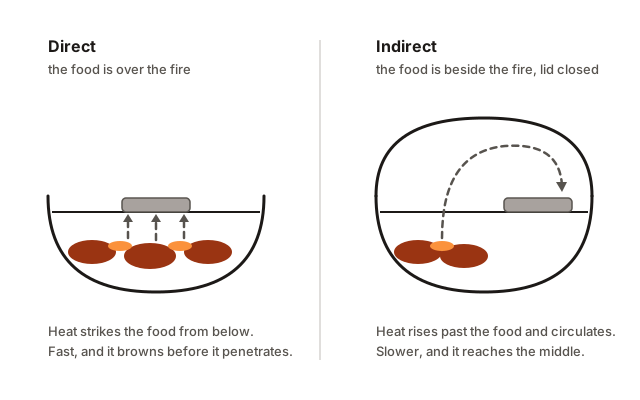
Food directly above the fire. Fast, radiant, and the most effective way to drive the surface browning and char that make a steak taste like a steak — but the surface reaches its finish long before the centre of anything thick.
Fire directly below · radiant heat · lid open
Indirect heat
Food beside or above no fire at all, with the lid down so the chamber does the cooking. Slower and far more even, which is what thicker pieces usually benefit from: the centre can cook through without the outside over-browning.
Fire beside · convective heat · lid closed
Two-zone fire
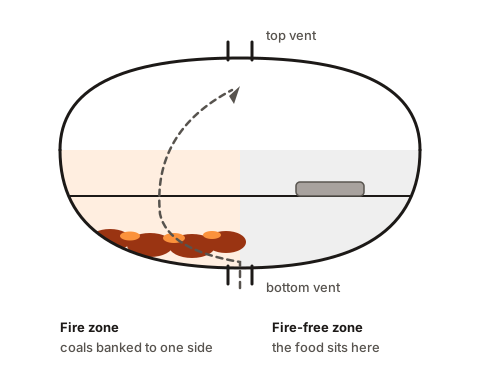
One fire, two areas: coals banked to one side leave a hot zone and a cool one. The single most useful setup on any cooker, because it lets you move food rather than adjust a fire that will not be hurried.
Fire beside · mixed heat · lid either
Smoking
Cooking in a chamber where smoke is a deliberate ingredient rather than a by-product, with the fire well away from the food.
Fire separate chamber · convective heat · lid closed
Low and slow
Sustained low temperature for many hours, so that collagen has time to convert. Time is doing work here that temperature cannot do faster.
Fire beside · convective heat · lid closed
Ember cooking
Food placed directly into or onto the embers with no grate at all. Ancient, and still the best way to cook a whole pepper or an onion.
Fire embers in contact · conductive heat · lid open
Enclosed oven
A closed domestic oven. Kept separate from live-fire cooking because an enclosed oven is not the same cook, so its timings are never mixed with them, rather than being excluded and lost or included and merged.
Fire surrounding · convective heat · lid closed
Smoke woods
Note what these entries do not claim. The flavour descriptions are marked as widely reported rather than established, because BBQHQ has retrieved no sensory study behind any of them — the wood charts across the internet appear to be copying each other. The safety note is a different matter entirely.
Treated, painted or salvaged timber
Not a smoking wood and not a fuel. Construction timber, pallets, offcuts, painted or stained wood and anything of unknown origin belong in none of the categories on this page.
Pressure-treated wood may contain arsenic or other toxic compounds, and painted or salvaged timber may carry anything at all. The Culinary Institute of America's instruction is unambiguous — never use pressure-treated wood — and it extends by obvious reasoning to any wood whose treatment history is unknown. Buy smoking wood from somewhere that knows what it is.
Cherry
A fruitwood named by the Culinary Institute of America among the commonly used smoking woods. Like the other fruitwoods it is reached for when a lighter smoke is wanted, and like the other fruitwoods BBQHQ has found no institutional source establishing that it is lighter.
Described as: Mild, slightly sweet, reddens the surface — widely reported, not established by any source BBQHQ holds.
Mesquite
One of the four woods Texas A&M names as primary in Texas barbecue, and the one most often described as the strongest. It is also the wood that best illustrates the availability argument: mesquite is what grows across south and west Texas.
Described as: Assertive, earthy — widely reported, not established by any source BBQHQ holds.
Alder
Named by the Culinary Institute of America among the commonly used smoking woods. It is the traditional smoking wood of the Pacific Northwest, where it grows and where salmon is smoked — which is the availability argument again rather than a discovered affinity.
Described as: Light, delicate — widely reported, not established by any source BBQHQ holds.
Pecan
A nut wood and a close relative of hickory, named by Texas A&M as one of the four primary woods of Texas barbecue. Its relationship to hickory is genuine and structural — both are Carya — which is one of the few wood comparisons BBQHQ can make from botany rather than from repetition.
Described as: Nutty, in the hickory family — widely reported, not established by any source BBQHQ holds.
Oak
The workhorse smoking wood across several traditions, and the one most often recommended as a default. Oak is a genus rather than a species, so 'oak' covers woods that do not all behave identically.
Described as: Medium, rounded, not sharp — widely reported, not established by any source BBQHQ holds.
Apple
A fruitwood, commonly used where a lighter smoke character is wanted.
Described as: Mild, slightly sweet — widely reported, not established by any source BBQHQ holds.
Hickory
Strongly associated with American barbecue. Not native to Britain, so UK cooks encounter it as an imported product rather than as local wood — one of several ways barbecue advice fails to travel.
Described as: Strong, described as bacon-like — widely reported, not established by any source BBQHQ holds.
Wine and whiskey barrel staves
Reclaimed oak from used barrels, documented in Tennessee barbecue. Included because it is a useful corrective: a smoking 'wood' is not always a species, and what a piece of wood previously held is part of what it is.
Described as: Documented in use; no sourced sensory description — widely reported, not established by any source BBQHQ holds.
Suitable where the staves are genuinely from a cooperage barrel, which is untreated oak. The general rule about treated, painted or manufactured timber applies with force here, because reclaimed wood is exactly where treated timber gets in by mistake.
Softwoods (pine, spruce, fir)
Resinous conifers, generally avoided for smoking. Recorded so the distinction between 'unpleasant' and 'dangerous' is made explicitly rather than left to the reader.
Described as: Resinous, acrid, sooty — widely reported, not established by any source BBQHQ holds.
Resin produces heavy sooty smoke that tastes acrid and deposits on food. This is a quality problem rather than a poisoning one, and it is worth separating from the genuine hazard: TREATED, PAINTED OR MANUFACTURED TIMBER must never be burned for cooking, because the preservatives and adhesives in it can release genuinely toxic compounds. Conflating the two makes the serious warning easier to ignore.