Barbecue leftovers
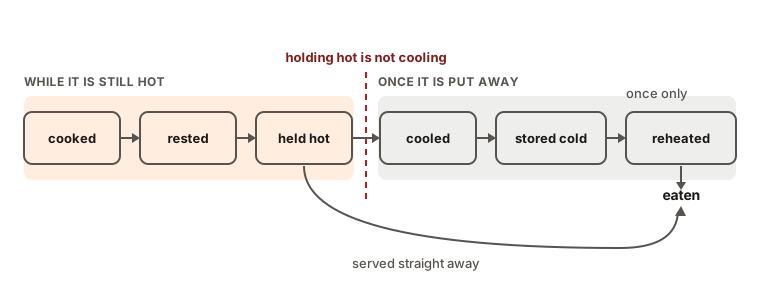
Three separate things happen to food after it comes off the fire, and the guidance for each comes from a different sentence: getting it cold, keeping it, and heating it up again. This page keeps them apart, because a reader asking how long something keeps is not helped by a rule about reheating it.
Everything below is general guidance about cooked barbecue food. Neither authority distinguishes between a brisket and a grilled pepper, and BBQHQ does not add a distinction they do not make.
Getting it cold
What has to happen between the barbecue and the fridge?
Food Standards Agency · GB-ENG, GB-WLS, GB-NIR
Cover the food and let it cool quickly at room temperature, then get it into a fridge or a cool bag with ice packs within one to two hours — sooner on a hot day.
- Into the fridge within
- 60 min–2h
What the authority actually says
“cover and cool cooked foods quickly at room temperature. Place them in a fridge or cool bag (with ice packs) within one to two hours, especially on hot days.”
Cooked food from a domestic barbecue, of any kind. The guidance does not distinguish between cuts, species or forms.
Food Standards Scotland · GB-SCT
Let hot food cool down before it goes in, then refrigerate it as soon as you can. Food Standards Scotland gives the order rather than a deadline: there is no Scottish equivalent of the FSA's one-to-two-hour window.
Refrigeration stops or slows bacterial growth, which is the reason Food Standards Scotland gives in the same sentence.
What the authority actually says
“put leftover food in the fridge as soon as possible as this helps to stop or slow down bacterial growth. Hot food needs to cool down first before storing in the fridge”
Leftover food from a domestic barbecue in Scotland, of any kind.
Food Standards Australia New Zealand · AU, NZRule for food businesses
A food business in Australia or New Zealand must cool cooked potentially hazardous food to 21 °C within two hours, and from 21 °C down to 5 °C within a further four hours. A different cooling process is permitted where the business can show it keeps the food safe. This is a requirement on commercial premises rather than advice to somebody cooling their own barbecue leftovers at home.
The published reason is the growth band itself: harmful microorganisms grow fastest between 21 °C and 60 °C, so the first stage is short, and the risk of growth slows as the temperature falls, so the second stage is allowed to be longer.
- Into the fridge within
- 2h
What the authority actually says
“When cooling cooked potentially hazardous food, it must be cooled to 21°C in two hours or less, then cooled further from 21°C to 5°C in four hours or less. You can use a different cooling process but you must be able to show that it keeps the food safe.”
Cooked potentially hazardous food being cooled for later use in the course of a food business in Australia or New Zealand.
How long it keeps
How long can it stay there?
Food Standards Agency · GB-ENG, GB-WLS, GB-NIR
Look to eat barbecue leftovers within 48 hours of cooking them. Freezing them is offered as an alternative, with no time limit attached to it.
- Eat within
- 48 hours
- Freezing
- offered, with no time limit given
What the authority actually says
“You should look to consume the leftovers from your barbecue within 48 hours.”
Cooked leftovers from a domestic barbecue, of any kind. No food is singled out and none is excluded.
Food Standards Scotland · GB-SCT
Eat leftovers within two days. Freezing is offered as another way of keeping them, again with no time limit attached.
Any longer gives harmful bacteria time to grow and multiply — Food Standards Scotland states the reason, where the FSA states only the figure.
- Eat within
- two days
- Freezing
- offered, with no time limit given
What the authority actually says
“eat leftovers within two days – any longer gives time for any harmful bacteria to grow and multiply”
Leftover food from a domestic barbecue in Scotland, of any kind.
Heating it up again
What may I do with it afterwards?
Food Standards Agency · GB-ENG, GB-WLS, GB-NIR
Reheat it once and once only, and get it steaming hot before it is served. The Food Standards Agency publishes no temperature for this and no method.
- Reheat at most
- once
What the authority actually says
“If you're reheating anything, only reheat it once and make sure it's steaming hot before serving.”
Anything left over from a domestic barbecue that is being heated up again.
Food Standards Scotland · GB-SCT
Reheat it once only, and make sure it is steaming hot all the way through before you eat it. No temperature is published for consumers and no method.
- Reheat at most
- once
What the authority actually says
“only reheat leftovers once and make sure it's steaming hot all the way through before eating”
Leftover food from a domestic barbecue in Scotland that is being heated up again.
Food Standards Scotland · GB-SCTRule for food businesses
A food business in Scotland must reheat food to not less than 82 °C before serving it for immediate consumption. This is a regulatory requirement on commercial premises, not the advice given to somebody reheating their own barbecue at home — for that, see the consumer guidance above.
- Reheat to
- 82 °C
What the authority actually says
“food which is reheated before service for immediate consumption shall be reheated to a temperature of not less than 82°C”
Food reheated before service for immediate consumption, in the course of a food business in Scotland.
Food Standards Australia New Zealand · AU, NZRule for food businesses
A food business in Australia or New Zealand reheating food in order to hot-hold it must heat it quickly to 60 °C or hotter, ideally within two hours, and must not use hot-holding equipment to do the reheating. The 60 °C figure is the temperature food must reach before it goes into hot holding — it is not an endpoint published for reheating leftovers to eat, and the same document separately advises against reheating any potentially hazardous food more than once.
The published reason for heating quickly rather than slowly is that holding equipment takes too long or does not heat the food enough to keep it safe.
- Reheat to
- 60 °C
What the authority actually says
“If you are reheating potentially hazardous food to hot hold, you must heat it quickly to 60°C or hotter — ideally in two hours or less. … avoid reheating potentially hazardous food more than once, so it doesn’t go through multiple warming periods”
Potentially hazardous food being reheated in the course of a food business in Australia or New Zealand, in order to hold it hot for service.
What nobody publishes
- A reheating temperature for people cooking at home. Both UK authorities say “steaming hot” and neither attaches a figure. The 70 °C for two minutes on BBQHQ’s food safety page is for cooking raw food and is not carried across to reheating cooked food.
- A reheating method. Oven, microwave, grill and pan are all absent from the guidance. BBQHQ can tell you the standard to reach and not how to reach it.
- How long frozen leftovers keep. Both authorities offer freezing and neither gives a duration.
- Consumer guidance for readers outside the United Kingdom. BBQHQ has not retrieved consumer leftovers guidance from the American, Canadian, Australian or New Zealand authorities, and does not show British figures to readers they do not cover. Australian and New Zealand rules for FOOD BUSINESSES are shown above and are labelled as such — they are what that regulator publishes, and a caterer’s hot-holding floor is not advice to somebody reheating last night’s barbecue. The American and Canadian pages that would answer this are recorded in the manual capture queue: both refuse automated access, which is a closed door rather than an absence of guidance.