Your first barbecue
Nobody is born knowing this and none of it is difficult. Six decisions, in the order they actually arrive — and for each one, what BBQHQ knows, where the knowledge came from, and what happens if it goes wrong.
The single most useful thing on this page: a barbecue never goes indoors, into a tent, or into a garage — not while it is lit, and not while it is cooling. Charcoal and gas both produce carbon monoxide, it has no smell, and a cooling barbecue is still producing it.
1. Which barbecue
If you have one already, skip this. If you do not, the honest summary is that the decision is between tending a fire and setting a number, and everything else follows from it. Charcoal asks more of you and gives you the thing people mean when they say barbecue; gas asks almost nothing and will not smoke anything.
BBQHQ will not tell you which to buy, and the reason is not diplomacy. Ranking two cookers means deciding whether portability matters more than capacity, and nothing in the evidence answers that — it depends on whether you have a car boot or a patio. What the chooser does instead is ask six questions and show you which kinds fit, which nearly fit, and the exact sentence that ruled out each one that did not.
2. What to buy with it
Almost nothing. A barbecue is sold beside a fourteen-piece tool set containing one thing that matters, and BBQHQ names three objects as essential — each one because something published says what it does, not because it feels necessary.
A thermometer is the one that changes what you can do. Most of what this site knows ends at a temperature, and without an instrument to read it you are guessing at the only question that matters on chicken, burgers and sausages. A probe you push into the food for a few seconds to find out what the middle is doing. The one tool that turns most of BBQHQ's guidance from reading into cooking.
A chimney starter, if the barbecue burns charcoal. A steel cylinder with a grate near the bottom and a handle on the side. Charcoal goes in the top, something burns underneath, and the chimney does the rest.
Something to pick things up with — long tongs, and a pair of gloves if you are pouring a chimney, which is a two-handed job.
3. Lighting it
For charcoal: fill a chimney starter, stand it on the charcoal grate over two lighter cubes or some oiled newspaper, and light it through the holes in the bottom. In roughly fifteen minutes — weather depending — the coals at the top turn grey with ash and are ready to pour. Watch for the ash rather than the clock; the fifteen minutes is the part that varies.
Two insulated gloves and both handles to pour it. Then put the empty chimney somewhere nobody will walk into it, because it stays dangerously hot long after it looks finished.
Never pour petrol, paraffin or methylated spirits onto a barbecue, whether it is lit or not. That is RoSPA’s instruction, it names those three substances specifically, and firelighters are what it points to instead. Meths is the one worth naming twice: it is in a lot of sheds and it burns with a flame that is hard to see in daylight.
For gas: open the lid before you light it, every time. A closed lid lets gas collect, and the result is not a barbecue lighting.
4. Where the food goes, which is the real technique
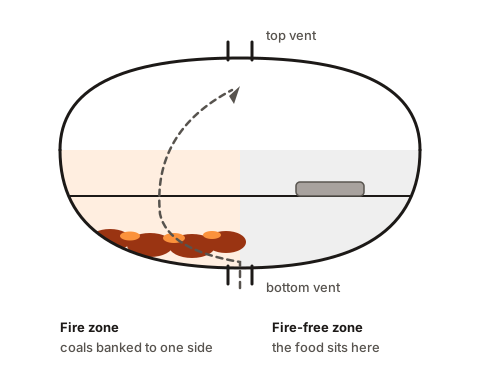
This is the decision that separates food you meant to make from food you did not, and almost nobody is told about it before their first attempt. You are not choosing a temperature. You are choosing whether the fire is under the food or beside it.
Directly over the fire, the outside cooks much faster than the inside — which is right for a steak, a sausage or a prawn, and is why a chicken thigh cooked that way is black outside and raw at the bone. Beside the fire with the lid down, the whole thing cooks at once, more slowly and more evenly. Almost every beginner disappointment is one of these two arrangements used for the other one’s food.
The practical version is to build the fire on one side only. Then you have both, and you can move food between them, which is the single most useful habit on this page.
5. Knowing when it is done
Colour tells you nothing reliable. Browning is a surface reaction and the middle of the food is where the answer is, which is why the thermometer is the one piece of equipment BBQHQ argues for.
Put the probe into the thickest part, not touching bone, fat or gristle — those are three separate wrong answers rather than one, and bone in particular reads high, so a probe against a chicken’s thigh bone will tell you a raw bird is cooked. Push it in the full length of the sensing area, past the little dimple stamped near the point. A burger has no thick part to go into from above, so go in from the side.
The temperature you are looking for depends on where you live — the UK, the United States, Canada and Australia genuinely do not agree, and BBQHQ does not average them. It is printed on each food’s own page against your territory.
6. What to cook first
Not because these are easy — because BBQHQ holds real cooking evidence for each of them and each has a test you can apply rather than a judgement you have to make. A steak is harder for a beginner than a sausage, and the reason is that nobody can tell you what medium-rare feels like.
Chicken thigh, bone-in
The most forgiving piece of chicken and the one where the safety endpoint and the good endpoint point in the same direction — thighs improve past the temperature at which they become safe.
Chicken thigh, boneless
A thigh with the bone out and usually the skin off, which turns an irregular lump into a flat slab and roughly quarters the cooking time. Treated as a separate food precisely because the sources time it separately.
Chicken breast, boneless
Lean breast meat with no bone and no skin, and the least forgiving thing on this list: it has no fat to buy time with and its safety endpoint is above the point at which it starts drying out.
Chicken breast, bone-in
Breast on the bone with the skin on. Slower and considerably more forgiving than the boneless version, because the bone slows the heat and the skin protects the surface.
Chicken wings
Mostly skin and connective tissue over very little meat, which inverts the usual problem: wings are not about reaching an internal temperature, they are about rendering the skin, and that takes longer.
Chicken drumsticks
Working leg muscle around a single bone. Like the thigh, better past its safety minimum, and unlike the thigh, a cylinder — so it cooks from all sides at once.
It will go wrong, and that is not a sign you cannot do it
Something on the first attempt will stick to the bars, flare up, come out dry, or be black outside and cold inside. Every one of those has a cause, most of them have several causes that look identical on the day, and BBQHQ’s troubleshooting pages exist to tell them apart rather than to offer general advice.
The single most common one is food sticking, and the answer is nearly always that it was not ready to be turned. Protein releases from the grate when it has formed a crust; a piece of chicken that will not lift is a piece of chicken telling you to wait.
The rules that are not negotiable
Read out of BBQHQ’s safety model rather than written here, so this page cannot fall behind it. Each one links to the authority that publishes it.
Carbon monoxide
Never take a barbecue into a tent, awning, caravan, motorhome, garage, shed or any other enclosed space — including to keep warm, and including when it is no longer flaming.
Carbon monoxide
A barbecue continues to give off carbon monoxide as it cools. Never bring one inside to finish cooling, and never store one indoors until it is completely cold.
Carbon monoxide
An electric smoker's heat comes from a mains element that burns nothing, and the appliance still emits carbon monoxide, because the wood chips it makes smoke with are burning inside the cabinet. Masterbuilt warns that burning wood chips gives off carbon monoxide, which has no odour and can cause death, and that chips must never be burned inside homes, vehicles, tents, garages or any enclosed area.
Fuel handling
After a charcoal fire appears extinguished, unconsumed embers can retain heat for up to 24 hours and can burst into flame unexpectedly when fresh air reaches them. Embers outside the firebox can ignite combustible surfaces such as a wooden deck.
There are more, and which apply depends on what you are cooking on. All of them, by hazard.
Where to go next
Your food, your cooker, your setup — a window with the reasoning attached, and a refusal where the evidence runs out.
Direct, indirect, and the rest
The arrangements in full, with the cross-sections that make the difference obvious.
What your barbecue can actually do
Every kind, what owning one is like, and what is harder about it.
Fire, gas, carbon monoxide and the socket
By hazard rather than by cooker, because the ones that matter do not depend on what you bought.