The one piece of equipment that turns most of what BBQHQ knows from reading into cooking — and the one most often used in a way that makes it lie. Which kind does what, how far in it has to go, and where in the food it belongs.
Where the probe goes, and the three things it must not be touching.
This page does not give a safe temperature for any food. Those differ between countries by real margins — the UK, the United States, Canada and Australia do not agree — so they live on the food pages, where BBQHQ knows which rules apply to you.
Why the depth matters more than the price
A digital instant-read senses temperature at the very tip of its probe. A dial thermometer with a thick stem senses along the whole coil inside it, which runs two to two and a half inches up from the point. That single difference decides almost everything else about how the two are used.
Push a dial thermometer a centimetre into a burger and it is not giving you a slightly rough reading of the middle. It is averaging the middle, the outside, the air and the grate — and it will usually read high, because the grate is hotter than the food. That is the specific failure that makes people confident about an undercooked patty, and it is a property of the instrument rather than a mistake in technique.
Which is why the useful question is never “is this a good thermometer” but “is this the kind of thermometer for the thing I am cooking”. A dial thermometer is entirely accurate in a leg of lamb.
Eight kinds of instrument
As published by Clemson Cooperative Extension, which compares the classes side by side and sells none of them. The inch figures are the source’s own; the millimetres are a conversion of those figures rather than a separate measurement.
Instrument
Reads in
Insert
Leave in while cooking?
Thin foods?
Digital instant-read (thermistor)
10 seconds
at least ½ inchabout 13 mm
Not designed to
Yes — it senses at the tip
Thermocouple
2–5 seconds
¼ inch or deeperabout 6 mm
Not designed to
Yes — the shallowest of them all
Digital fork
2–10 seconds
at least ¼ inchabout 6 mm
Not designed to
Yes
Dial instant-read (bimetallic)
15–20 seconds
2–2½ inchesabout 50–64 mm
Not designed to
No — the stem senses along its length
Dial oven-safe (bimetallic)
1–2 minutes
2–2½ inchesabout 50–64 mm
Designed to
No — the source says not appropriate for thin foods
Liquid-filled
not stated
at least 2 inchesabout 51 mm
Designed to
No — the source says not appropriate for thin foods
Disposable indicator
5–10 seconds
about ½ inchabout 13 mm
Not designed to
Yes
Oven cord
not stated
not stated—
Designed to
Not stated
Where the probe goes
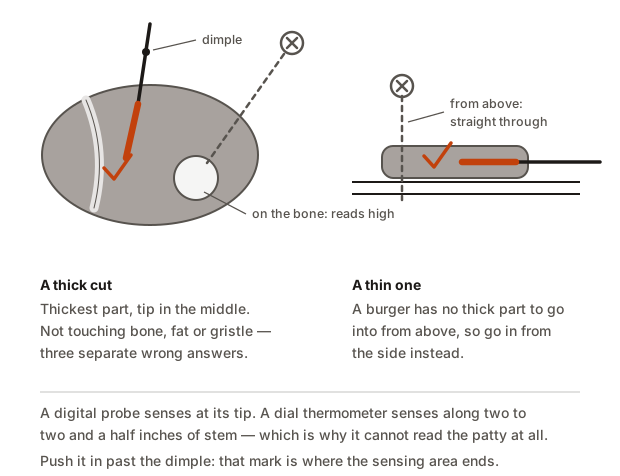
The thickest part of the food, not touching bone, fat or gristle, and pushed in the full length of the sensing area — past the little dimple stamped near the point, which is the mark showing where the sensing area ends.
Those three exclusions are three different wrong answers rather than one. Bone conducts heat and reads high, so a probe resting against the thigh bone of a chicken reports a bird that is done when it is not. Fat and gristle behave differently again from muscle and are simply not what you are trying to measure. BBQHQ’s diagnosis for a chicken that came out pink at the bone turns on exactly this distinction.
A burger has no thick part to go into from above, which is why the instruction for thin patties is to go in from the side.
Checking one is telling the truth
Fill a glass with finely crushed ice, top it with cold water and stir. Put the stem in at least two inches, touching neither the sides nor the bottom, and wait at least thirty seconds. It should read 32 °F, which is 0 °C — the same fixed point in two scales rather than a converted measurement.
Most home instant-reads cannot be adjusted, and that does not make the check pointless. The useful outcome is knowing the offset: a thermometer that reads two degrees high in ice water reads two degrees high in a joint of beef, and you can work with that. One that is wildly out is one to replace.
The source names a boiling-water method as well and gives no procedure for it, so neither does BBQHQ. Water also boils at a temperature that depends on your altitude, which makes the fixed point at freezing the safer one to publish.
The two you would actually own
Instant-read thermometer
It reports the temperature at the very tip of a thin probe, which is why it can find the coldest point of a piece of meat rather than an average of it. Clemson gives a digital thermistor ten seconds and half an inch of insertion, and a thermocouple two to five seconds at a quarter of an inch — both sense at the tip, which is what lets them read a burger or a fillet. A dial thermometer with a fat stem senses along two to two and a half inches of its length, so it cannot read anything thinner than that and will report the average of everything it is touching, including the grate.
When it earns its place
▲Any food with a safety endpoint — poultry, mince, burgers, sausages, rolled or stuffed joints.
▲Any cut expensive enough that overcooking it matters, which is most of the reason people buy one.
▲Cooking for other people, where the difference between your judgement and a number is who gets ill.
What it will not do
▼It will not tell you what the cooker is doing. That is a different instrument in a different place, and a probe left lying on the grate reads the grate.
▼It will not survive being left in the food through a lid-down cook — Clemson lists instant-read types as not designed to remain in food while it is cooking.
▼It will not correct a bad reading position. In the wrong part of the meat, or against a bone, it is confidently wrong rather than approximately right.
Leave-in probe thermometer
It solves the specific problem of the long cook: every time a lid comes off to take a reading, the cooker loses heat it then has to rebuild, and on a smoker that is measured in tens of minutes. A leave-in probe is designed to sit in the food for the whole cook with the chamber shut — Clemson lists the oven-cord type as designed to remain in the food while it is cooking, alongside the oven-safe dial and the liquid-filled types. Many of them carry a second probe for the air temperature beside the food, which answers the other half of the question.
When it earns its place
▲Any cook long enough that opening the lid costs real time — brisket, pork shoulder, a whole bird on a smoker.
▲Overnight cooks, where the useful thing is an alarm rather than a reading.
▲Cookers with a big gap between the dial setting and what the grate is actually doing.
What it will not do
▼It will not replace an instant-read. One probe reports one point, and the point you chose at the start is not necessarily the last part to come up.
▼It will not read a thin food. The same depth problem applies, and a probe in a steak is mostly a probe in the air above it.
▼It will not tell you the cooker is fine because the meat is fine, or the reverse — they are two measurements and both can mislead alone.
Washing it, which is the step everyone skips half of
Hot soapy water on the stem before and after each use, and the head does not go in water. Before matters as much as after: a probe that has been in an underdone bird and then goes into the next one has moved raw juice from the middle of one piece of meat to the middle of another, which is a route no cooking temperature protects against.