Gravity-fed charcoal cooker
A column of charcoal that feeds itself into the fire, with a fan holding whatever temperature you set.
- Runs on Lump charcoal or Charcoal briquettes or Electricity
- Smoke Charcoal combustion, Oak chunks
- Attention Set it and leave it
- Feeds A full table
- Learning Takes a few cooks
- Moving it Movable, with effort
- Needs Mains power
What it is good at, and what is harder
What it is good at
- Real lump charcoal and a set temperature at the same time, which nothing else here offers — the offset gives you the first and the pellet grill the second.
- The hopper feeds the fire for hours without the lid coming off, so a long cook loses none of the heat that refuelling normally costs.
- One cooker covers a 107 °C brisket smoke and a 371 °C sear, a span no other single machine in this catalogue holds.
- It comes up fast for a charcoal cooker: its maker states 225 °F in eight minutes.
What is harder
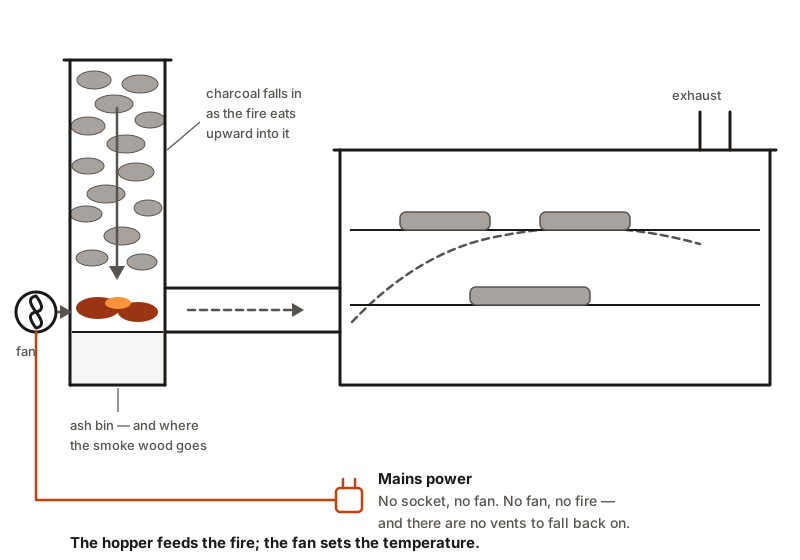
- No mains power, no cooker. The fan and the controller stop, and a charcoal fire with a dead fan is not a cooker you can nurse along on vents — there are none to work with.
- It is a complicated machine by charcoal standards: a controller, a fan, a temperature probe and a hopper, each of which is a thing that can fail.
- Ash and grease management matter more than on a simple cooker, because ash falling into the wrong place is also where the smoke wood goes.
- Its maker prohibits fast-light charcoal and lighting fluid outright, which rules out the fuel a lot of people have in the shed.
The comparisons on this page are BBQHQ's reading of each maker's own manual set beside the others. No manufacturer here has said anything about a competitor's cooker, and none would be admitted as evidence if it had.
Carbon monoxide — read this first
Do not use this in an enclosed space — including a garage, a tent, a porch or a shed with the door shut. BBQHQ has no manufacturer instruction permitting it.
This is recorded from a source, never inferred from what it burns. BBQHQ does not derive indoor safety from the absence of combustion — an electric cooker still presents fire and smoke risk, and only its own manufacturer’s instruction can permit enclosed-space use.
How it works
Charcoal stands in a tall hopper beside the cooking chamber and falls into the fire as the coals below it burn away, so the fire feeds itself for hours without the lid coming off. A digitally controlled fan pushes the air rather than a vent restricting it, which is how one cooker holds a 107 °C smoke and a 371 °C sear — and why it needs a socket.
What heats it
- Lump charcoal
Wood burned in the absence of oxygen until only carbon remains. Lights faster and burns hotter than briquettes, less predictably, and leaves less ash.
- Charcoal briquettes
Compressed charcoal with binders, uniform in size and therefore in behaviour. Burns cooler and longer than lump, which is exactly what a long cook wants.
- Electricity
Mains power driving a heating element, or a controller and fan on a cooker that burns something else. Produces no carbon monoxide — which says nothing whatever about whether the appliance may be used indoors.
Where the smoke comes from
- Charcoal combustion
The modest smoke character charcoal contributes on its own, plus what comes from fat dripping onto the coals. Frequently the only smoke source in a cook that nobody thought of as smoking.
- Oak chunks
Fist-sized pieces placed on or beside a fire. Large enough to smoulder for a long time rather than flaring and finishing in five minutes, which is what makes chunks the default for long cooks.
What you can cook on it
Smoking — Designed for this
- Smoke comes from wood chunks no larger than a fist, put directly into the ash bin rather than onto the fire.
Low and slow — Designed for this
Direct heat — Designed for this
Indirect heat — Designed for this
Two-zone fire — Possible with the right setup
- The fire is a fixed column rather than a bed of coals you can bank, so zones come from where the food sits in the chamber rather than from moving the fuel.
Is this the one for you?
Written as conditions rather than as types of cook, because the same person wants different things in June and in November.
Get this if
- You want charcoal cooking without spending the afternoon at a firebox door.
- You want one machine that will smoke on Saturday and sear steaks on Sunday.
- There is a weatherproof outdoor socket where you cook, and you are content for the cook to depend on it.
Look at something else if
- You cook away from the house, on a campsite, or anywhere power is not certain.
- You want the fewest possible things that can break, in which case a kettle or a drum is the better answer.
- Tending the fire is the part you enjoy — this design exists to take that away from you.
Your first cook on it
- Take the intake slides out and open both the hopper lid and the ash door before you light anything.
- Light a fire starter in the charcoal grate, give it a minute or two to catch properly, and only then switch the controller on and set a temperature. The other order runs the fan over unlit fuel.
- For smoke, put one or two wood chunks no bigger than your fist straight into the ash bin rather than on the fire.
Worth cooking on it
Techniques it supports
Fast cooking over direct heat. What most of the world means by barbecuing, and what American barbecue specifically does not mean — a terminology collision worth knowing about before reading any recipe.
Cooking with the lid down and the fire to one side, turning the barbecue into an oven that happens to smell of woodsmoke. The default for anything large.
Bring the food up slowly on indirect heat, then finish it hot and fast over direct. One method, two heat configurations, in that order — which is exactly why the technique and the fire arrangement are described separately here.
Many hours at low temperature with smoke, until collagen-rich cuts become tender. The method that gives American barbecue its name and its arguments.
Very hot, very short contact to develop surface colour and flavour. Not, despite the persistent belief, a way of sealing in juices.
Small pieces threaded onto skewers and cooked close over an open fire. Included because three separately sourced traditions turn out to share it, and because the skewer material — iron, bamboo, lemongrass, bicycle spoke — is a real variable that the sources themselves distinguish.
Looking after it
Keeping it working, which is a different subject from keeping it safe. The safety rules are above and below; these are the jobs that decide whether it still holds a temperature in three years.
- Clear the ash bin between cooks. It is also where the smoke wood goes, so a full bin costs you both airflow and smoke.
- Check nothing has slipped through the charcoal grate into the ash can before lighting.
- It plugs in and lives outdoors, so the lead is part of the cooker: outdoor-rated, uncoiled, checked before it goes in, and unplugged before you clean or adjust anything.
Safety for this cooker
Never take a barbecue into an enclosed space
Never take a barbecue into a tent, awning, caravan, motorhome, garage, shed or any other enclosed space — including to keep warm, and including when it is no longer flaming.
Burning charcoal, wood or gas produces carbon monoxide, which is colourless, odourless and gives no warning before it causes harm. In an enclosed space it accumulates to lethal concentrations.
Where this comes from
A barbecue continues to produce carbon monoxide as it cools. A barbecue that is no longer flaming is still lethal in an enclosed space.
Well established
Public Health Agency (Northern Ireland) — States this directly
“Even a cooling barbecue gives off plenty of poisonous carbon monoxide”
- Why it happens:
- Incomplete combustion continues while fuel is still smouldering.
- Combustion chemistry, so it does not vary by jurisdiction — unlike the food rules.
About this source · Original · retrieved 2026-08-13
Public Health Agency (Northern Ireland) — States this directly
A barbecue should never be taken into a tent, awning, caravan or motorhome, including when it is only cooling.
- What it covers:
- Applies to charcoal and other combustion barbecues.
- Carbon monoxide is colourless and odourless, so there is no warning before symptoms.
About this source · Original · retrieved 2026-08-13
London Fire Brigade — States this directly
“After cooking, let it cool and make sure it is properly out – smouldering ashes can give off dangerous carbon monoxide fumes and can be fatal.”
- An independent authority reaching the same conclusion as the Public Health Agency by a different route — a fire service rather than a public-health body.
About this source · Original · retrieved 2026-08-13
Spent coals can reignite for up to 24 hours
After a charcoal fire appears extinguished, unconsumed embers can retain heat for up to 24 hours and can burst into flame unexpectedly when fresh air reaches them. Embers outside the firebox can ignite combustible surfaces such as a wooden deck.
BBQHQ already carried the UK fire-authority instruction on how to dispose of coals. What it did not carry was HOW LONG the risk lasts, and 24 hours is a great deal longer than the interval most people assume from a barbecue that has gone cold to the touch on top. Filed under 'fuel' — the disposal and handling of charcoal — rather than under 'fire', which is jurisdiction-bound because fire regulations are national and this is a manufacturer's statement about the material rather than a fire authority's about a country. It sits alongside the UK fire-authority rule rather than replacing it.
Where this comes from
A charcoal fire that appears extinguished can retain heat in unconsumed embers for up to 24 hours and can flare again when fresh air reaches it, which is why spent fuel is a fire risk long after a cook has finished.
Well supported
Oklahoma Joe's (Char-Broil, LLC) — States this directly
“After a charcoal fire appears extinguished, unconsumed embers can retain heat for up to 24 hours, and if exposed to fresh air, can burst into flame unexpectedly.”
- The figure:
- Twenty-four hours is a longer interval than any other document in this catalogue gives for a dead-looking fire, and it is a manufacturer stating it about its own charcoal appliance.
About this source · Original · retrieved 2026-08-20
UK: use a residual current device for anything that plugs in
Use a residual current device with any mains-powered cooker or equipment used outdoors. If your fusebox does not have one built in, use a plug-in RCD at the socket.
An RCD is the thing that turns cutting through a lead from a fatality into a tripped switch. Electrical Safety First and RoSPA both give this advice and neither states a milliamp rating, so neither does this rule. The 30 mA figure elsewhere in BBQHQ is Masterbuilt's instruction about Masterbuilt's smoker and is shown as that.
Where this comes from
In the UK, mains-powered equipment used outdoors should be protected by a residual current device, and a plug-in RCD should be used where the fusebox does not have one built in.
Well supported
Electrical Safety First — States this directly
“Use a residual current device (RCD) with all outdoor electrical equipment. If you don't have one built into your fusebox, use a plug-in RCD.”
- No milliamp figure is given, and that is recorded deliberately. Masterbuilt specifies 30 mA for its own smoker and the temptation is to read the two together into 'a 30 mA RCD is required'. Neither source says that. The charity says use an RCD; the manufacturer says 30 mA for its appliance. BBQHQ states each in the voice that said it.
- What it covers:
- All outdoor electrical equipment as a class. A mains-powered smoker is in scope because it is a mains appliance used outdoors, not because the source mentions cooking — it does not.
- Where it applies:
- The United Kingdom. Electrical Safety First is a UK charity writing for UK homes.
About this source · Original · retrieved 2026-08-21
Royal Society for the Prevention of Accidents (RoSPA) — States this directly
“Use a residual current device (RCD) for electrically-powered equipment to protect against the risks of electrocution ... Check for any damage before you use, like worn or frayed cables, broken parts or signs equipment has got wet ... Never use electrical equipment in wet conditions ... Switch off and unplug electrical items before cleaning, adjusting or checking them.”
- A second publisher, not a restatement. RoSPA reaches the same advice as Electrical Safety First from an accident-prevention remit rather than an electrical one, and neither cites the other. The count should read two, because there are two.
- The unplug-before-adjusting instruction is the one that bites on a cooker. Clearing a probe, moving a chip tray or wiping an element are all 'adjusting', and all of them are done mid-cook with the appliance live.
About this source · Original · retrieved 2026-08-21
UK: dew counts as wet
Do not run a mains-powered cooker outdoors while the ground or the equipment is wet. Electrical Safety First sets the threshold at dew on the ground, not at rain.
This is the rule that decides the case a long cook actually presents. A ten-hour smoke started in the afternoon finishes after dark on wet grass, and the test most people apply is whether it is raining. The source deliberately sets a lower bar than that, and it is the single most useful sentence in the electrical domain for anybody running a cabinet smoker overnight.
Where this comes from
In the UK, mains-powered equipment should not be used outdoors while the ground or the equipment is wet, and the stated threshold is dew rather than rain.
Well supported
Electrical Safety First — States this directly
“Electricity and water don't mix so, even if there is just dew on the ground, don't use electrical equipment outdoors until it is dry.”
- The sentence that decides the case an electric smoker actually presents. a ten-hour cook that starts in the afternoon ends after dark on wet grass, and 'it is not raining' is the test most people would apply. The source sets a lower bar than that on purpose.
- Written about garden equipment generally. BBQHQ applies it to mains-powered cookers because they are mains equipment used outdoors, and says so rather than implying the source named them.
About this source · Original · retrieved 2026-08-21
Royal Society for the Prevention of Accidents (RoSPA) — States this directly
“Use a residual current device (RCD) for electrically-powered equipment to protect against the risks of electrocution ... Check for any damage before you use, like worn or frayed cables, broken parts or signs equipment has got wet ... Never use electrical equipment in wet conditions ... Switch off and unplug electrical items before cleaning, adjusting or checking them.”
- A second publisher, not a restatement. RoSPA reaches the same advice as Electrical Safety First from an accident-prevention remit rather than an electrical one, and neither cites the other. The count should read two, because there are two.
- The unplug-before-adjusting instruction is the one that bites on a cooker. Clearing a probe, moving a chip tray or wiping an element are all 'adjusting', and all of them are done mid-cook with the appliance live.
About this source · Original · retrieved 2026-08-21
UK: the lead is part of the appliance
Use only extension leads, reels and connectors rated for outdoor use — weather-resistant, with moulded connections. Check them for damage before plugging in, uncoil a reel completely, and use one with a thermal cut-out.
The cooker is chosen once and the lead is chosen every time, usually from whatever is in the shed. A coiled reel under load is a heater rather than a shock hazard, which is why the instruction is to uncoil rather than merely to inspect — the failure it prevents is a fire.
Where this comes from
In the UK, extension leads, cable reels and connectors used outdoors should be ones rated for outdoor use, checked for damage before use and fully uncoiled, and cable reels should have a thermal cut-out.
Well supported
Electrical Safety First — States this directly
“Only use extension leads, cable reels, and connectors which are suitable for outdoor use. ... Before using them, check they are clean and free from damage, and fully uncoil them to prevent overheating.”
- The lead is the part of an electric smoker's installation that BBQHQ can say something useful about. The smoker is bought once and the lead is chosen every time it is used, usually from whatever is in the shed.
- The stated reason is overheating, not shock. A coiled reel under load is a heater, and the failure it produces is a fire rather than an electrocution.
About this source · Original · retrieved 2026-08-21
Royal Society for the Prevention of Accidents (RoSPA) — Background and context
“Use a residual current device (RCD) for electrically-powered equipment to protect against the risks of electrocution ... Check for any damage before you use, like worn or frayed cables, broken parts or signs equipment has got wet ... Never use electrical equipment in wet conditions ... Switch off and unplug electrical items before cleaning, adjusting or checking them.”
- A second publisher, not a restatement. RoSPA reaches the same advice as Electrical Safety First from an accident-prevention remit rather than an electrical one, and neither cites the other. The count should read two, because there are two.
- The unplug-before-adjusting instruction is the one that bites on a cooker. Clearing a probe, moving a chip tray or wiping an element are all 'adjusting', and all of them are done mid-cook with the appliance live.
About this source · Original · retrieved 2026-08-21
UK: unplug before you fiddle with it
Switch off and unplug a mains-powered cooker before cleaning, adjusting or checking it.
On a cooker this is the instruction people break without noticing they are breaking it. Clearing a jammed auger, refilling a chip tray, wiping an element and reseating a probe are all adjusting, and all of them are done mid-cook with the appliance live and the cook's hands wet.
Where this comes from
In the UK, mains-powered equipment should be switched off and unplugged before it is cleaned, adjusted or checked.
Well established
Royal Society for the Prevention of Accidents (RoSPA) — States this directly
“Use a residual current device (RCD) for electrically-powered equipment to protect against the risks of electrocution ... Check for any damage before you use, like worn or frayed cables, broken parts or signs equipment has got wet ... Never use electrical equipment in wet conditions ... Switch off and unplug electrical items before cleaning, adjusting or checking them.”
- A second publisher, not a restatement. RoSPA reaches the same advice as Electrical Safety First from an accident-prevention remit rather than an electrical one, and neither cites the other. The count should read two, because there are two.
- The unplug-before-adjusting instruction is the one that bites on a cooker. Clearing a probe, moving a chip tray or wiping an element are all 'adjusting', and all of them are done mid-cook with the appliance live.
About this source · Original · retrieved 2026-08-21
UK: never pour petrol, paraffin or meths on a barbecue
Never pour petrol, paraffin or methylated spirits onto a barbecue or a fire, lit or unlit. Use firelighters, or a chimney starter.
RoSPA names the three substances rather than saying 'accelerants', and the naming is the useful part — meths in particular is in a lot of sheds and burns with a flame that is hard to see in daylight. The alternative BBQHQ points at is a chimney starter, because the reason people reach for a bottle is that lighting charcoal with a match is slow, and a chimney is the answer to that problem rather than a rebuke for having it.
Where this comes from
Petrol, paraffin and methylated spirits should never be poured onto a barbecue or fire; firelighters are the intended alternative.
Well established
Royal Society for the Prevention of Accidents (RoSPA) — States this directly
“Never pour petrol, paraffin or meths onto the fire, use firelighters”
- The sentence the accessory layer needed. a chimney starter is the thing somebody reaches for instead of an accelerant, and a page recommending one should be able to say what it is instead OF from a source rather than from folklore. Weber describes the chimney and has a chimney to sell; RoSPA states the prohibition and sells nothing.
- Three substances, named. Recorded as named rather than generalised to 'accelerants', because the generalisation is BBQHQ's and the list is RoSPA's.
About this source · Original · retrieved 2026-08-21
What we don't know about this
The maker does not publish what electrical supply this cooker needs. BBQHQ can say it stops working without mains power, but not what that supply has to be.
Where to go next
Answer six questions about how you cook and see which kinds of cooker fit — and which do not.
All eleven families on one page, grouped by what they are for.
Work back from when you want to eat, through resting, cooking and lighting the fire.