Cuts, and what they are called elsewhere
A cut name only means something inside a butchery tradition. These mappings say how close the correspondence really is — and where there isn’t one, they say that instead of offering a name that will get you the wrong meat.
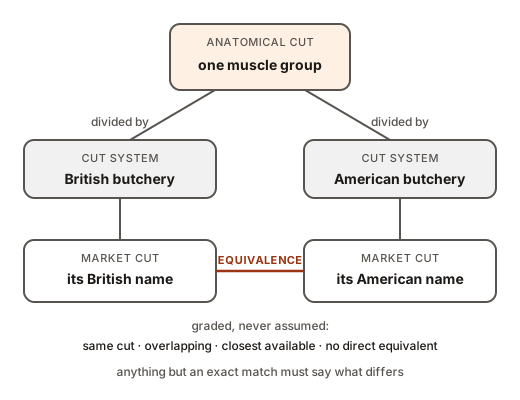
What the mappings actually say
Every cut below carries its correspondences to the other butchery systems, and each one is graded rather than asserted. That grading is the point of the page. Most reference tables answer “what is picanha in Britain” with a name, and the truthful answer is often that there isn’t one — British butchery divides the rump differently, so no British cut is that cut.
- Overlapping cut — 24 mappings
- Closest available — 3 mappings
- No direct equivalent — 9 mappings
The last of those is not a gap in the data. It is a result, and it is only expressible because non-equivalence is modelled as an outcome rather than as a row nobody filled in. A table that could not say it would quietly hand you the closest-sounding name and let you find out at the counter.
The same word, different meat
BBQHQ records 75 names for these 40 cuts, because a cut has as many names as there are counters selling it. 16 of those names are ambiguous — they mean different cuts to different people, and they are the ones that send somebody home with the wrong thing.
Following an American recipe with a British cut of the same name is the everyday version of this, and it is not a small error: it can mean a considerably more expensive piece of meat, or a considerably tougher one, cooked by a method chosen for neither.
“brisket flat” — US
Means different cuts to different trades here
Ask for: Say 'brisket flat' or 'first cut' if you want the lean muscle alone, and 'whole packer' if you want point and flat together.
“butt” — US
Means different cuts to different trades here
Ask for: Pork shoulder from the blade end, bone in.
“delmonico” — US
Means different cuts to different trades here
“flank steak” — US
Means different cuts in different butchery systems
Ask for: Bavette, or flank if the counter uses American names.
“flanken” — US
Means different cuts to different trades here
Ask for: Say whether you want it cut across the bones (flanken) or between them (English).
“lamb rib chop” — US
Means different cuts in different butchery systems
Every cut, by animal
Grouped by animal rather than by country, because the question people arrive with is about a piece of meat and not about a butchery tradition. The system each cut belongs to is printed beside it.
Beef (16)
Brisket
UK butchery
The UK's version of the cut that American barbecue is built on — related, but not the same thing arriving in a different accent.
- Overlapping cut in US butchery — Packer brisket
Rib eye
UK butchery
A well-marbled steak from the rib, suited to fast, hot cooking.
- Overlapping cut in US butchery — Ribeye steak
Sirloin steak
UK butchery
A steak from the loin behind the ribs. The cut where the word 'sirloin' causes the most transatlantic trouble: in Britain it is this premium steak, and in the United States it names a different, cheaper cut from further back.
- Overlapping cut in US butchery — Strip steak
Rump steak
UK butchery
The British steak counter's default: cut across the muscles over the hip, leaner and coarser than sirloin and priced accordingly.
Bavette
UK butchery
A thin sheet from the abdominal wall with a grain coarse enough to see. Bavette, flank and skirt are neighbouring cuts that different systems divide differently, which is why the aliases here are approximate rather than equivalent.
Fillet steak
UK butchery
Cut across the psoas major, the muscle that does least work on the animal. The one cut where British and American names agree on the thing while disagreeing on the word.
T-bone steak
UK butchery
A cross-section of the loin with the vertebra left in, so sirloin sits on one side of the bone and fillet on the other. Two muscles, one steak, and different requirements either side.
Rump cap
UK butchery
The cap muscle off the top of the rump, with its fat layer. AHDB separates it along the natural seam and names it picanha in the specification — so a UK butcher can supply it, and the thing to get right is the fat.
- Overlapping cut in Brazilian butchery — Picanha
- Overlapping cut in US butchery — Coulotte
Picanha
Brazilian butchery
The cut most often asked about across butchery systems. BBQHQ once recorded it as having no British equivalent; the British cutting specification turned out to use the word.
- Overlapping cut in UK butchery — Rump cap
Packer brisket
US butchery
The whole pectoral section, point and flat together, as sold in the US. The defining cut of Texas barbecue.
- Overlapping cut in UK butchery — Brisket
Ribeye steak
US butchery
The US rib eye. Registered separately from the UK cut so the mapping between them is a record rather than an assumption.
- Overlapping cut in UK butchery — Rib eye
Strip steak
US butchery
The US name for the loin steak a British butcher calls sirloin. Included because the word 'sirloin' means different cuts on either side of the Atlantic, which is the single most expensive naming trap in beef.
- Overlapping cut in UK butchery — Sirloin steak
Coulotte
US butchery
The American name for the rump cap. Three systems, three names, one muscle — and the names disagree about which primal it belongs to, which is why the anatomical record is the thing that holds them together.
- Overlapping cut in UK butchery — Rump cap
Tri-tip
US butchery
A triangular muscle from the bottom sirloin, central to Californian Santa Maria barbecue and effectively unavailable in British retail. The clearest case in the catalogue where the honest answer is that the cut does not exist here.
- No direct equivalent in UK butchery
Beef short ribs
US butchery
The barbecue cut whose name is least reliable. 'Short ribs' can mean thick plate ribs, chuck ribs or thin cross-cut strips, and the three cook completely differently.
- Closest available in UK butchery — Beef ribs
Beef ribs
UK butchery
British beef ribs, sold under several names including Jacob's ladder. Worth asking exactly which ribs you are getting, because the answer changes the cook by hours.
- Closest available in US butchery — Beef short ribs
Pork (12)
Gammon steak
UK butchery
A slice of cured hind leg. The curing is the defining property rather than the anatomy: salt through the meat and usually sugar on the surface, both of which change how it behaves over fire.
Pork shoulder
UK butchery
A collagen-rich shoulder joint, the standard candidate for a long low cook.
- Overlapping cut in US butchery — Boston butt
Boston butt
US butchery
The upper part of the pork front shoulder as divided in US butchery, IMPS item 406, and the cut most American pulled-pork guidance assumes. Its name is actively misleading outside the US.
- Overlapping cut in UK butchery — Pork shoulder
Picnic shoulder
US butchery
The other half of the pork front shoulder. Kept separate so that 'Boston butt' means one specific cut here rather than a regional synonym for shoulder.
- Overlapping cut in UK butchery — Pork shoulder
Pork loin chop
UK butchery
A chop from the loin: lean, low in collagen, and easy to overcook.
- No direct equivalent in US butchery
Pork belly
UK butchery
Layered fat and muscle from the underside. The cut Korean gogi-gui is built on, sliced thin, and a long-cook joint when left whole.
- No direct equivalent in US butchery
Pork tenderloin
UK butchery
The leanest muscle on the pig and the fastest-cooking cut in this catalogue. Its main hazard is its name's similarity to 'pork loin', which is a completely different and much larger cut.
- Overlapping cut in US butchery — Pork tenderloin
Pork tenderloin
US butchery
The US name for the psoas major, the cut the National Pork Board times separately.
- Overlapping cut in UK butchery — Pork tenderloin
Loin back ribs
US butchery
Ribs from the top of the rib cage where it meets the loin. Shorter, leaner and quicker than spareribs, and the two are constantly confused.
- Overlapping cut in UK butchery — Loin ribs
Loin ribs
UK butchery
The British counterpart of baby back ribs, off the loin.
- Overlapping cut in US butchery — Loin back ribs
Spareribs
US butchery
The full rib rack off the belly. Bigger, fattier and slower than loin ribs — and the cut where BBQHQ's two independent publishers give times that do not overlap.
- No direct equivalent in UK butchery
- Overlapping cut in US butchery — St Louis-style ribs
St Louis-style ribs
US butchery
Spareribs trimmed to a rectangle. Worth recording separately because it is a TRIM, not an anatomy — the model has to be able to say that two products from the same bones are different things to cook.
- No direct equivalent in UK butchery
Lamb (12)
Rack of lamb
UK butchery
The rib chops left joined as one piece, usually trimmed so the bone ends are exposed. Small enough to cook like a thick steak rather than like the roast it resembles.
Lamb leg chops, boneless
US butchery
IMPS item 1234, cut from any boneless leg item in the 234 series with the shank and heel meat excluded. The nearest American thing to a British lamb steak, and sold under a different name.
- Overlapping cut in UK butchery — Lamb leg steak
Lamb leg center-cut steak, bone-in
US butchery
IMPS item 1233E, which must show a cross-section of the femur — and no other bone — on both faces of the steak. Recorded because it is the half of the American leg-steak family that Britain does not have.
- No direct equivalent in UK butchery
Lamb loin chops
US butchery
IMPS item 1232A, from any bone-in loin item, containing no hipbone. Called a T-bone chop when the tenderloin comes with it.
- Overlapping cut in UK butchery — Lamb loin chop
Lamb rib chops
US butchery
IMPS items 1204B to 1204F, cut from the rack. The cut a British butcher calls a cutlet, and a different item number from the loin chop it is routinely confused with.
- Closest available in UK butchery — Lamb loin chop
Lamb shoulder, square-cut
US butchery
IMPS item 206 reduced to item 207: foreshank and brisket off, neck trimmed to no more than three cervical vertebrae. The American shoulder is a more closely defined object than the British one.
- Overlapping cut in UK butchery — Lamb shoulder
Lamb shoulder
UK butchery
The working shoulder: more fat and collagen than the leg, and the lamb joint that rewards a long indirect cook.
- Overlapping cut in US butchery — Lamb shoulder, square-cut
Leg of lamb
UK butchery
Leaner than the shoulder. Butterflied it becomes a slab of even thickness and a genuinely fast barbecue cut; left whole it is a long one.
- No direct equivalent in US butchery
Lamb leg steak
UK butchery
A steak cut across the leg. AHDB times it by thickness, which makes it one of the few cuts in the catalogue with a British duration source.
- Overlapping cut in US butchery — Lamb leg chops, boneless
Lamb loin chop
UK butchery
A chop off the loin, bone in. AHDB gives it 6–8 minutes a side at 2 cm — noticeably longer than a lamb steak of the same thickness, because a chop carries a bone and a fat edge.
- Overlapping cut in US butchery — Lamb loin chops
Barnsley chop
UK butchery
A double lamb chop cut straight across the unsplit loin, with a maximum fat cover of 6 mm under AHDB Loin L018. BBQHQ holds no cooking time for it: AHDB's grilling guide covers chops and cutlets and does not name this cut, and a chop with two eyes and a folded flank is not a single chop with a longer time.
- No direct equivalent in US butchery
Lamb Henry
UK butchery
A bone-in quarter of lamb shoulder, scored, from AHDB Forequarter L029. A collagen-heavy portion cut that behaves like a small shoulder rather than like a chop — and BBQHQ holds no duration for it, which is why it appears in the cut catalogue and not in the cook chooser.
- No direct equivalent in US butchery