Foods & cuts · Wheat dough
Pizza
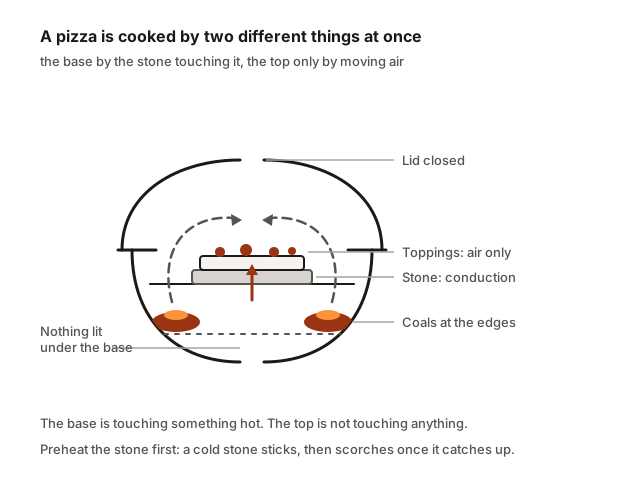
The one food on a barbecue where the heat arrives from the wrong side. A base sits on metal or stone conducting heat straight into it while the toppings wait on air, and almost everything that goes wrong with a pizza over fire is that imbalance.
What it is
- Form
- Dough round
- Typical weight
- 300–600 g
- Typical thickness
- 5–20 mm
- Cut
- Not a cut of anything
Why it behaves as it does
Three arrangements, and they are genuinely different cooks rather than settings on one. Fresh dough over DIRECT heat is grilled on one face, flipped, topped on the cooked side and finished — the dough is cooked before a topping ever meets it. A stone preheated over direct heat then held at a higher grill temperature behaves like an oven floor and takes 7-10 minutes. Frozen and deep-pan pizzas go INDIRECT and take four to five times as long, because there is nothing to be gained from a fierce base under a pizza that is mostly waiting for its middle. Weber states all three and states the failure too: too much heat burns the base before the top is ready. BBQHQ PUBLISHES A WINDOW FOR THE FIRST TWO AND NOT THE THIRD: a frozen pizza is a packaged product and its cooking requirement belongs to its manufacturer, which is also the position Weber takes — its own instruction is sixteen to twenty minutes "or follow the directions on the box". Use the packet, and take the indirect arrangement from here.
When is it done?
Food-safety endpoint
BBQHQ holds no food-safety rule for this food. We are not showing you another jurisdiction’s figure in its place — check your national food-safety authority.
Texture endpoint — how you actually know
Blistered and dry to the touch on both faces
The first face comes off the bars marked, puffed in patches and dry — not pale and floppy. That is what tells you the second side can carry toppings. Dough that still feels damp when it is flipped will steam under the toppings and never firm up, and no extra time at the end recovers it.
How long it takes
Pizza, fresh dough over direct heat
Estimated cooking window
6 min–8 min
Moderate confidence
Why this is a range, not a number
- Cookers hold temperature imperfectly
- Individual animals and pieces differ
- How often the lid comes off
Cook to the endpoint, not to the clock. The window tells you when to start checking.
What this rests on
BBQHQ publishes a window for this cook.
- Observations
- 1
- Documents
- 1
- Publishers timing this cook
- 1
Weber-Stephen Products
Why confidence is not higher
- Several documents, but all from one publisher.
- All timing evidence comes from equipment manufacturers describing their own products.
How the sources were combined
THE ARRANGEMENT THAT SOLVES THE PROBLEM RATHER THAN MANAGING IT. A pizza base burns before its top cooks because the base is against hot metal and the top is in air. Weber's direct method removes the conflict instead of balancing it: the naked dough is grilled on one face for 3-4 minutes, flipped, topped on the already-cooked side, and given 3-4 minutes more — so the toppings are being warmed on a base that is already done rather than raced against it. The 6-8 minute total is the publisher's own two halves added together, not BBQHQ doubling a per-side figure; the article describes both halves and the flip between them. One publisher, and a manufacturer. Iowa State University Extension independently describes the same family of setup — preheat, lid down, a vessel that takes fierce heat — and states no time, so the arrangement has two voices and the numbers have one.
What makes the window as wide as it is
- Cookers hold temperature imperfectly
- Individual animals and pieces differ
- How often the lid comes off
Pizza, on a preheated stone
Estimated cooking window
7 min–10 min
Moderate confidence
Why this is a range, not a number
- Cookers hold temperature imperfectly
- Individual animals and pieces differ
- How often the lid comes off
Cook to the endpoint, not to the clock. The window tells you when to start checking.
What this rests on
BBQHQ publishes a window for this cook.
- Observations
- 1
- Documents
- 1
- Publishers timing this cook
- 1
Weber-Stephen Products
Why confidence is not higher
- Several documents, but all from one publisher.
- All timing evidence comes from equipment manufacturers describing their own products.
How the sources were combined
THE THIRTY-MINUTE PREHEAT IS THE INSTRUCTION, NOT THE SEVEN-TO-TEN MINUTES. Weber calls preheating the stone over direct heat for half an hour the key step, and attaches the reason: a stone that has not soaked up enough heat is what makes the base stick to it and then burn once it finally does get hot. A reader who takes the 7-10 minute window and skips the preheat has taken the part of this record that does not work on its own. The stone is doing what an oven floor does — holding enough stored heat to cook a base from below without a live fire underneath it — and the grill temperature is what keeps the top moving. One publisher, and it sells pizza stones; the arrangement is separately described by Iowa State University Extension, which names a stone or a cast-iron skillet and gives no figures.
What makes the window as wide as it is
- Cookers hold temperature imperfectly
- Individual animals and pieces differ
- How often the lid comes off
When it goes wrong
- Burnt outside, underdone inside
- Pizza base burnt before the top was cooked — 3 distinguishable causes.
- It stuck to the grate
- Food sticking to the grate — 2 distinguishable causes.
Afterwards
Cooling, keeping and reheating what is left is general guidance for barbecue leftovers. Neither UK authority publishes anything specific to pizza, and BBQHQ does not invent a distinction they do not make.