Offset smoker
A fire in one box and food in another, run by hand for the whole cook — the traditional way, and the most involved.
- Runs on Wood or Lump charcoal
- Smoke Oak chunks
- Attention Hands on throughout
- Feeds A crowd
- Learning Rewards practice
- Moving it Stays where you put it
What it is good at, and what is harder
What it is good at
- The fire is never under the food, so there is no flare-up and no drip-fed smoke, only what the chamber carries across.
- It burns logs. Wood is the recommended fuel here rather than a flavour additive, which is the difference this architecture exists for.
- Chamber capacity is large enough to cook for a crowd in one run.
- Everything that governs the cook is visible and adjustable: how much wood, how much air in, how much out.
What is harder
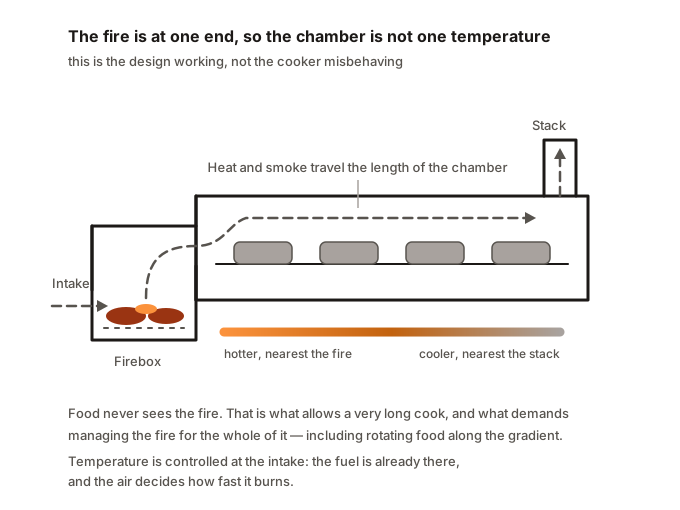
- It runs a temperature gradient along the chamber. Food at the firebox end cooks faster and swapping positions is part of the job.
- The fire needs feeding through the whole cook. This is not a machine you set and go to bed on.
- Thin steel loses heat to wind and cold, and a bad-weather cook costs fuel and attention.
- A poorly managed fire produces heavy, acrid smoke, so the failure mode is on the plate rather than on a display.
The comparisons on this page are BBQHQ's reading of each maker's own manual set beside the others. No manufacturer here has said anything about a competitor's cooker, and none would be admitted as evidence if it had.
Carbon monoxide — read this first
Do not use this in an enclosed space — including a garage, a tent, a porch or a shed with the door shut. BBQHQ has no manufacturer instruction permitting it.
This is recorded from a source, never inferred from what it burns. BBQHQ does not derive indoor safety from the absence of combustion — an electric cooker still presents fire and smoke risk, and only its own manufacturer’s instruction can permit enclosed-space use.
How it works
A cooking chamber with the firebox attached at one end, so heat and smoke travel horizontally across the food. The defining consequence is a temperature gradient along the chamber, which is a nuisance to manage and the reason the design produces what it does.
What heats it
- Wood
Burning wood directly, so fuel and smoke are the same material. Demands the most attention of any fuel and gives the most control over the character of the smoke.
- Lump charcoal
Wood burned in the absence of oxygen until only carbon remains. Lights faster and burns hotter than briquettes, less predictably, and leaves less ash.
Where the smoke comes from
- Oak chunks
Fist-sized pieces placed on or beside a fire. Large enough to smoulder for a long time rather than flaring and finishing in five minutes, which is what makes chunks the default for long cooks.
What you can cook on it
Smoking — Designed for this
Low and slow — Designed for this
Indirect heat — Designed for this
What it will not do: direct heat. That is a fact about the architecture rather than a gap in the evidence — no accessory changes it.
Is this the one for you?
Written as conditions rather than as types of cook, because the same person wants different things in June and in November.
Get this if
- Fire management is the part you want, not the part you want removed.
- You cook big — briskets and whole shoulders for a table full of people.
- You want the results a wood fire gives and accept an eight-hour relationship with it.
Look at something else if
- You want to start a cook and do something else all day.
- You are learning to smoke and would rather the cooker helped.
Your first cook on it
- Burn the fire down before closing the doors, then control it with the firebox damper and the stack.
- Use seasoned hardwood and burn the bark off first — its acid content is what makes smoke taste acrid.
- Keep the chamber below about 230 °C; this design is not meant to be run hot.
Worth cooking on it
Techniques it supports
Cooking with the lid down and the fire to one side, turning the barbecue into an oven that happens to smell of woodsmoke. The default for anything large.
Bring the food up slowly on indirect heat, then finish it hot and fast over direct. One method, two heat configurations, in that order — which is exactly why the technique and the fire arrangement are described separately here.
Many hours at low temperature with smoke, until collagen-rich cuts become tender. The method that gives American barbecue its name and its arguments.
Looking after it
Keeping it working, which is a different subject from keeping it safe. The safety rules are above and below; these are the jobs that decide whether it still holds a temperature in three years.
- Clear the ash out after every cook — it holds moisture against the steel and that is what rusts a firebox through.
- Wipe the interior with a light coat of cooking oil, and never paint inside the chamber.
- Check where the smoke escapes; a chamber that leaks everywhere cannot be controlled by its dampers.
Safety for this cooker
Never take a barbecue into an enclosed space
Never take a barbecue into a tent, awning, caravan, motorhome, garage, shed or any other enclosed space — including to keep warm, and including when it is no longer flaming.
Burning charcoal, wood or gas produces carbon monoxide, which is colourless, odourless and gives no warning before it causes harm. In an enclosed space it accumulates to lethal concentrations.
Where this comes from
A barbecue continues to produce carbon monoxide as it cools. A barbecue that is no longer flaming is still lethal in an enclosed space.
Well established
Public Health Agency (Northern Ireland) — States this directly
“Even a cooling barbecue gives off plenty of poisonous carbon monoxide”
- Why it happens:
- Incomplete combustion continues while fuel is still smouldering.
- Combustion chemistry, so it does not vary by jurisdiction — unlike the food rules.
About this source · Original · retrieved 2026-08-13
Public Health Agency (Northern Ireland) — States this directly
A barbecue should never be taken into a tent, awning, caravan or motorhome, including when it is only cooling.
- What it covers:
- Applies to charcoal and other combustion barbecues.
- Carbon monoxide is colourless and odourless, so there is no warning before symptoms.
About this source · Original · retrieved 2026-08-13
London Fire Brigade — States this directly
“After cooking, let it cool and make sure it is properly out – smouldering ashes can give off dangerous carbon monoxide fumes and can be fatal.”
- An independent authority reaching the same conclusion as the Public Health Agency by a different route — a fire service rather than a public-health body.
About this source · Original · retrieved 2026-08-13
Where to go next
Bullet water smoker or Offset smoker?
The first real decision anybody makes about smoking, and it is not about results — it is about how you want to spend the day. One holds its own temperature with a pan of water; the other holds it because you are standing there.
Ceramic kamado or Offset smoker?
Two serious low-and-slow cookers, differing in capacity, in fuel consumption and in how hot they will also go when you want a steak.
Answer six questions about how you cook and see which kinds of cooker fit — and which do not.
All eleven families on one page, grouped by what they are for.
Work back from when you want to eat, through resting, cooking and lighting the fire.