The perfect burger
There is one fact about cooking a burger that matters more than every other fact combined, and it is not about the meat, the fat, the bun or the fire. It is that a burger is not a steak — and four national food-safety authorities agree about that while disagreeing about almost everything else.
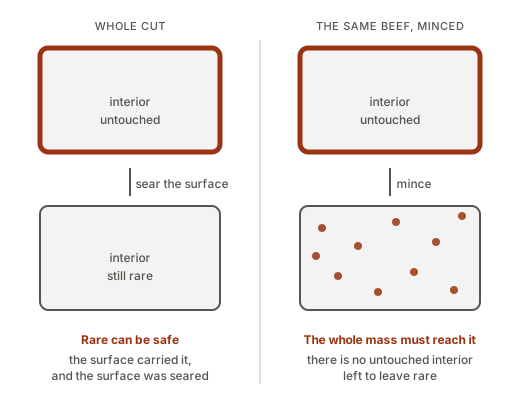
The same animal, minced instead of sliced, becomes a different safety proposition. Bacteria that lived only on the outside of a piece of beef are distributed right through a burger by the mincing, so the whole mass has to reach the endpoint. A rare steak can be safe. A rare burger is a different question, and the authorities answer it differently from how they answer the steak one.
1. Why a burger is not a steak
A whole cut of beef is essentially sterile inside. Whatever contamination it carries arrived on the surface, in the abattoir or the butchery or the packet, and it stays there — which is why searing the outside of a steak deals with it and why the middle can be left rare without that being a compromise.
Mincing destroys that geometry. It takes the surface — all of it, from every piece that went into the batch — and folds it through the interior, so there is no longer an inside and an outside in the sense that mattered. That is the whole mechanism, and everything below follows from it.
The same animal as a steak and a completely different safety proposition. Mincing takes bacteria that lived on the surface and distributes them through the interior, so the whole mass has to reach the endpoint.
It is worth being precise about what this is not. It is not a claim that burgers are dangerous, or that anyone who has eaten a pink one has been lucky. It is that the reason a rare steak is fine does not transfer, so the question has to be answered on its own terms — and four authorities have answered it.
2. Four authorities, four answers, and no average
Read out of BBQHQ’s safety model rather than written here. Each row is one authority’s rule for a burger, set against the same authority’s rule for a whole cut where it publishes one. The contrast within a row is the point; the differences between rows are real disagreements between governments and are not reconciled here, because they are decisions rather than competing estimates of one fact.
England, Wales and Northern Ireland (Food Standards Agency)
A beef burger must be cooked through. Serving one rare or pink requires specific controls that ordinary domestic cooking does not provide, and which a whole cut of beef does not need.
And the same authority, on a whole cut: The Food Standards Agency states that whole cuts of red meat such as steaks can be served pink, rare or bloody and will be safe to eat as long as the surface has been adequately seared. It gives no internal temperature for this case, so there is no figure here to cook to — the searing of the surface is the condition.
United States (USDA FSIS)
In the United States, ground beef should reach a minimum internal temperature of 160 °F (71 °C).
And the same authority, on a whole cut: In the United States, whole cuts of beef, pork, lamb and veal — steaks, chops and roasts — should reach 145 °F (63 °C), followed by a rest of at least three minutes before carving or eating.
Canada (Health Canada)
In Canada, ground beef, veal and lamb — including burgers, meatballs and sausages — should reach 71 °C (160 °F).
BBQHQ holds no paired whole-cut rule from this authority, so the contrast cannot be drawn here without inventing half of it.
Australia and New Zealand (FSANZ)
Across Australia and New Zealand, cook chicken, sausages and hamburgers thoroughly to an internal temperature of 75 °C, checked with a food thermometer. Steaks may be cooked to preference.
And the same authority, on a whole cut: FSANZ states that steaks can be cooked to preference, in the same guidance that requires chicken, sausages and hamburgers to reach 75 °C. No temperature is attached to the steak case.
Which of these applies to you depends on where you are, and BBQHQ prints the one for your territory on the burger’s own page rather than asking you to pick from a list. Averaging them would produce a figure no government publishes and no reader could cite.
3. The cook, which is the well-evidenced part
8–12 minutes over direct heat, for a patty of 110–200 g and 10–25 mm thick. That window is unusually well supported for this catalogue: two independent publishers, on two continents, whose figures overlap at compatible thicknesses. Most cooking windows here rest on one publisher or on a rate multiplied out.
It is also the part that matters least. A burger is thin, it is over direct heat, and eight to twelve minutes is not a difficult target to hit — whereas the endpoint is a number you cannot see, on a food where getting it wrong is the whole risk. This is one of the few foods in BBQHQ where the timing is well evidenced and the timing is not the answer.
Which is why the thermometer stops being optional here. A burger has no thick part to probe from above, so the probe goes in from the side, along the patty, the full length of the sensing area. That single technique is the difference between a measurement and a guess.
Then rest it for about 5 minutes. The University of Wyoming Extension puts fish, chicken breasts, pork chops and burgers together as thin cuts and gives them about five minutes, so the juices are reabsorbed rather than lost to the board. One publisher, and no second source BBQHQ holds addresses it.
4. What goes wrong
The three failures BBQHQ’s troubleshooting model records against a burger, pulled from the model rather than listed here. Each one has several causes that look identical on the day, which is what the diagnosis pages are for.
The sauce or glaze burnt black
The meat is fine and the outside is black and bitter. This is almost always a timing decision rather than a heat one, and it is decided by what the sauce is made of.
Flare-ups
Fat and juices reach the fire and ignite, throwing flame up around the food and blackening the outside long before the inside is done.
Food sticking to the grate
Food tears when it is turned, leaving skin or flesh welded to the bars.
Burgers or sausages charred outside and raw inside
The outside is charred and the middle is not cooked, which on a minced product is a food-safety problem rather than a cooking-quality one.
The flare-up one is worth a word here, because it is specific to this food: fat rendering out of a patty falls onto the fire, and a burger has more of it to give than almost anything else on the grate. That is a two-zone problem rather than a heat problem — you need somewhere to move it to.
5. The parts BBQHQ will not pretend to know
Everything above is something a named publisher established. What follows is the list of things a burger page is normally mostly made of, and for which BBQHQ has retrieved nothing at all:
- The fat percentage. Twenty per cent is the number everybody repeats. BBQHQ has not retrieved a source that establishes it, so it does not print it.
- The cut or blend of mince. Chuck, brisket, short rib and the ratios between them are a genuine craft and none of it is in this catalogue.
- Handling the mince. Whether working it less produces a better texture is stated everywhere and sourced nowhere here.
- Smashing, dimpling, pressing. All widely described, all currently unevidenced in this catalogue.
- The bun, the cheese and the order of assembly. Not a cooking question BBQHQ models at all.
None of that is an argument that those things do not matter — several of them plainly do. It is that a page which stated them with the same confidence as the endpoints above would be teaching a reader that the two kinds of statement are equally reliable, and they are not.
6. The other things that go in a bun
Lamb burger
Minced lamb, and therefore subject to exactly the same form rule as a beef burger: the interior is no longer sterile, so the whole mass has to reach the endpoint.
Plant-based burger
A category rather than a product. How it behaves on a grate can be described in general; what it must be cooked to is set by its manufacturer and printed on the packet.
Sausage
Seasoned minced meat in a casing, and the most-cooked thing on a British barbecue by a distance. Usually pork, frequently not — beef, lamb and mixed sausages are all ordinary — so the species on this record is the common case rather than a definition.
A lamb burger is minced meat and takes the minced-meat rule. A plant-based patty is not meat at all and takes its manufacturer’s instruction instead, which is a different kind of authority and is treated as one.
Where to go next
The window, the endpoint for your territory, the two publishers behind the timing, and the evidence trail for each.
Reading the middle of a thin patty
Probe from the side, past the dimple, the full length of the sensing area — and how to check the instrument is telling the truth.
The failure a burger is most prone to, its several causes, and how to tell which one you had.
Six decisions in the order they arrive, from which barbecue to buy to where the food goes.