Foods & cuts · Cod
Cod fillet
Large-flaked lean white fish, and the food in this catalogue most likely to fall through a grate in pieces.
What it is
- Form
- Fillet
- Typical weight
- 150–250 g
- Typical thickness
- 20–30 mm
- Cut
- Not a cut of anything
Why it behaves as it does
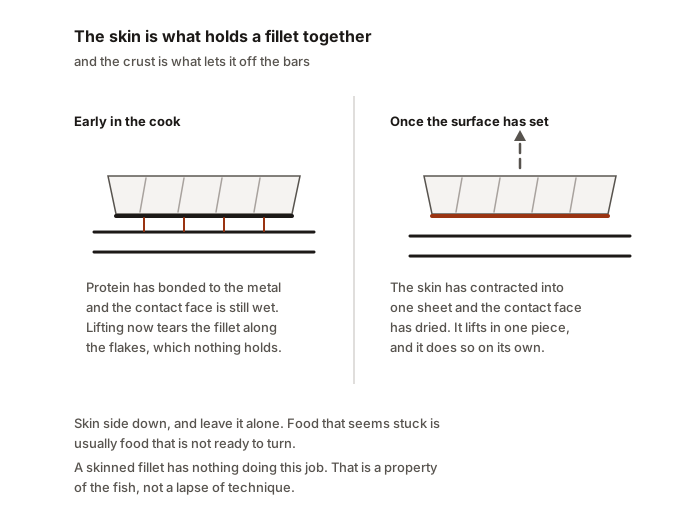
Cod's flakes are unusually large and separate cleanly, which is exactly what makes it pleasant to eat and impossible to turn. The failure is structural rather than a matter of skill, so the honest answers are equipment ones — a basket, a plank, foil, or a plancha — rather than advice to be gentler. Clemson's ten-minute rule applies by thickness: about ten minutes per inch, doubled if it is still frozen.
When is it done?
Food-safety endpoint
Food Standards Australia New Zealand
Use separate equipment for raw and cooked meat, and never put cooked meat back on a tray or plate that held it raw. Throw away leftovers unless there is refrigeration available to cool them quickly.
The rule and its source
At a barbecue, raw and cooked meat must be kept apart: separate equipment, and cooked meat never returned to the tray that held it raw.
Well established
Food Standards Australia New Zealand — States this directly
“never place cooked meat back on the trays that held the raw meat”
- The single most common barbecue food-safety failure, and one that no cooking temperature prevents.
- Where it applies:
- Australia and New Zealand.
About this source · Original · retrieved 2026-08-13
Food Standards Agency
In the UK, fish is cooked when the flesh has turned opaque — no longer transparent — and separates easily with a fork.
The rule and its source
In the UK, fish is cooked when the flesh has turned opaque and separates easily with a fork. The regulator gives no temperature for fish.
Well established
Food Standards Agency — States this directly
“fish flesh should turn opaque (no longer transparent) and separates easily with a fork”
- How it was measured:
- A visual and textural test, not a thermometer reading. The same document gives 70 °C for 2 minutes as the general combination for food, and does not apply a figure to fish.
- Where it applies:
- England, Wales and Northern Ireland.
About this source · Original · retrieved 2026-08-16
Food Standards Agency
Wash a thermometer stem in hot soapy water before and after each use, and do not put the head in water.
The rule and its source
A thermometer stem should be washed in hot soapy water before and after each use, and the head should not be put in water.
Well established
Clemson Cooperative Extension — States this directly
“Make sure to clean the stem of your food thermometer with hot soapy water before and after each use. Do not immerse the head in water.”
- Before and after, not just after. a probe that went into an undercooked bird and then into the next one is a cross-contamination route BBQHQ's food-safety model already recognises between surfaces and hands, and has never described for the instrument that touches every piece of meat on the grate.
- The head exclusion is an equipment instruction rather than a hygiene one — electronics — and is recorded here because it is in the same sentence and separating them would misquote the source.
About this source · Original · retrieved 2026-08-21
Texture endpoint — how you actually know
Opaque through, flaking under a fork
Cod flakes into unusually large, loose sheets — larger than salmon's — and the flesh turns from glassy to solid white. The Food Standards Agency and Clemson describe the same transition in different words, and both prefer it to a temperature. ASMI adds the part that matters on a grill: fish carries on cooking after it comes off, so it should leave the bars as soon as it is opaque rather than once it looks finished.
Where this comes from
Fish is timed by thickness rather than by weight. Clemson gives ten minutes per inch at 450 °F in an oven, with five minutes added in foil or sauce and double for frozen fish; Weber gives 8–10 minutes per inch on a grill. Doneness is a physical signal — the flesh just begins to flake and loses its translucency.
Well supported
Clemson Cooperative Extension — States this directly
“bake for 10 minutes per inch thickness of the fish, turning the fish halfway through the cooking time”
- Method:
- Stated for baking at 450 °F, NOT for grilling. The oven is the assumed appliance.
- How it was measured:
- Measured at the thickest point, after stuffing or rolling if either applies.
- Add 5 minutes if cooked in foil or in a sauce; double to 20 minutes per inch for fish cooked from frozen.
About this source · Original · retrieved 2026-08-13
Weber-Stephen Products LLC — States this directly
“General rule for grilling fish: 4 to 5 minutes per ½ inch thickness; 8 to 10 minutes per 1 inch thickness.”
- Form:
- Expressed per unit of thickness rather than per portion.
- Close to but not identical with Clemson's 10-minutes-per-inch rule, which assumes a 450 °F oven rather than a grill.
About this source · Original · retrieved 2026-08-13
Clemson Cooperative Extension — States this directly
“Fish is cooked when its meat just begins to flake easily when tested with a fork and it loses its translucent or raw appearance.”
- Form:
- A physical signal rather than a temperature — the shape a texture endpoint takes.
About this source · Original · retrieved 2026-08-13
How long it takes
Cod fillet, direct heat
Estimated cooking window
6 min–12 min
Moderate confidence
Why this is a range, not a number
- Thickness varies between pieces
- Cookers hold temperature imperfectly
- How cold the food was when it went on
Cook to the endpoint, not to the clock. The window tells you when to start checking.
What this rests on
BBQHQ publishes a window for this cook.
- Observations
- 2
- Documents
- 2
- Publishers timing this cook
- 2
Alaska Seafood Marketing Institute · Weber-Stephen Products LLC
Why confidence is not higher
- The window is BBQHQ's arithmetic on a source's per-unit rate, not a window the source published.
- At least one source does not state the cooker temperature.
- No source states whether the food went on fridge-cold or rested.
How the sources were combined
TWO PUBLISHERS, TWO CONTINENTS, AND A RATE RATHER THAN A WINDOW FROM BOTH. Weber gives 8-10 minutes per inch of thickness for grilling fish; the Alaska Seafood Marketing Institute gives approximately 10. Neither states a cod window, and neither states a window for any named fish — the rule is the unit in which fish timing is published. BBQHQ multiplies both across this profile's 20-30 mm envelope and publishes the union, 6-12 minutes, which is arithmetic on somebody else's rule and is labelled as such wherever it appears. The two rates overlap across their whole width, which is the cleanest agreement available when the shared figure is a rate: at any given thickness Weber's band contains ASMI's point. WHY THIS IS WIDER THAN SALMON'S 10-12 at a similar thickness: salmon's window is a figure Weber PRINTED for a 25-32 mm fillet, and a printed window carries its publisher's own judgement about the bottom of the band. A rate multiplied out has no such judgement in it and inherits the full width of the envelope instead. The difference is one of evidence basis, not of fish.
What makes the window as wide as it is
- Thickness varies between pieces
- Cookers hold temperature imperfectly
- How cold the food was when it went on
When it goes wrong
- It came out dry
- The fish came out dry — 2 distinguishable causes.
- It stuck to the grate
- Food sticking to the grate — 2 distinguishable causes.
- It fell apart
- Fish falling apart on the grill — 2 distinguishable causes.
Afterwards
Cooling, keeping and reheating what is left is general guidance for barbecue leftovers. Neither UK authority publishes anything specific to cod fillet, and BBQHQ does not invent a distinction they do not make.